Goddard School of Business & Economics
At the John B. Goddard School of Business & Economics, you get more.
A great college experience, an avenue to a great career and top placements in graduate schools are just some of the ways you receive big school-benefits with a small-college vibe.
At the Goddard School, our professors are exceptional scholars and teachers who are very invested in student success. Receive individual attention in small classes while making high-level business world connections.

We’ve been accredited by the Association to Advance Collegiate Schools of Business (AACSB International) since 1992 for both our business and accounting programs, a distinction held by less than 6% of business schools in the world.
This shows we continually meet rigorous standards for educational quality, and means you will get a very good education at a business school that’s among the top in the world.
Don’t just take it from us. Find out what some of our students and graduates have to say about how the Goddard School opened doors for them and set them up for success.
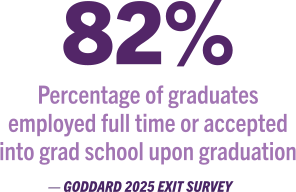
Outstanding Graduates and Students
Get to know some of the many outstanding graduates and students from the Goddard School:

I knew from the beginning that any knowledge I gained from the entrepreneurship program would help me in my business and for the rest of my life. I couldn’t have asked for a better undergraduate experience.
Alissa Jordan, Class of 2024

I knew that supply chain skills would always be marketable and a valuable skill set. And the staff is always willing to help; I think they would do anything to help you.
Dallin DeGroot, Class of 2024

Once I got into accounting, it came alive for me. I loved the structure and the rules, and the professors made it fun. I knew accounting was the right fit for me.
Leland Carney, Class of 2024

Marketing is so big in the world right now, and I love that there are lots of opportunities and different ways to apply it. There is no box with marketing.
McKinlee Nielsen, Class of 2024

Discover Our Degrees
The Goddard School has 13 bachelor’s degrees, three graduate degrees including the only Master of Taxation program in Utah, plus more than a dozen associate’s degrees, minors and certificate programs.
Check out some of our program highlights, and visit our Departments and Programs webpage for more information about our four departments and schools, and all of the amazing programs they offer.